You reach for a coffee mug and a sharp jolt runs down your forearm. You shake someone’s hand and wince. Carrying groceries in from the car, twisting a doorknob, lifting a laptop bag… these small moments turn into a running list of things that hurt. The pain does not stay in the elbow either. It travels into the forearm and steals your grip right when you need it.
Most people try the obvious first: a brace, ice, ibuprofen, and a few weeks of rest. Sometimes that quiets things down. Often it does not, because the tendon itself has stalled in the healing process and needs more than a break from activity. Elbow tendon pain is rarely solved by rest alone, because the problem is usually damaged tendon tissue that has stopped repairing itself, not simple swelling.
In this guide, you will learn what is actually hurting inside your elbow, why repetitive strain turns into a months-long problem, and what a real recovery plan looks like from home care to guided exercise to shockwave therapy. Lasting relief means gripping, lifting, and typing all day without thinking about your elbow.
Tennis Elbow and Golfer’s Elbow: What Is Actually Hurting?
Elbow pain from overuse almost always traces back to a tendon, not the joint itself. Which tendon depends on which side of your elbow hurts.
Outer Versus Inner Elbow Pain
Tennis elbow, known clinically as lateral epicondylitis, causes pain on the outside of the elbow at the bony bump called the lateral epicondyle. Golfer’s elbow, or medial epicondylitis, causes pain on the inside of the elbow instead.
Both are overuse injuries. Both involve tiny tears where forearm tendons anchor to bone. And most people who get either one have never picked up a racquet or a golf club.
The Tendons and Muscles Involved
Your wrist extensor muscles run along the top of your forearm and attach to the outside of the elbow. The main player in tennis elbow is a muscle called the extensor carpi radialis brevis, or ECRB. Every time you grip, lift with your palm down, or cock your wrist back, that tendon takes the load.
Golfer’s elbow involves the wrist flexors on the underside of your forearm. Over time, repeated pulling creates small areas of tendon damage that never fully knit back together, so the ache lingers.
Common Symptoms That Affect Everyday Tasks
The symptoms show up in ordinary moments more than during workouts:
- Pain or burning at the elbow that spreads into the forearm
- Weak grip strength when holding a mug, tool, or steering wheel
- Sharp pain when shaking hands or turning a doorknob
- Stiffness and reduced range of motion, especially in the morning
- Tenderness when you press directly on the bony bump
Once you know which tendon is involved, the next question is why it keeps hurting month after month.
Why Repetitive Strain Can Become a Long-Lasting Problem
Tendons heal slowly because they have limited blood supply. When you keep loading them before they recover, the damage outpaces the repair.
Activities That Keep Loading the Tendon
Racquet sports like tennis and squash get the credit, but daily activities are the bigger culprits. Typing with your wrists angled up, painting, using a screwdriver, hauling boxes, cutting hair, plumbing work, and lifting kids all repeat the same forearm motions hundreds of times.
The load is not dramatic, which is exactly the problem. Small repetitive activity spread across a workday adds up faster than one heavy lift.
Why Rest Alone May Not Restore Tendon Capacity
Rest calms the pain down. It does not rebuild the tendon’s ability to handle load. So you feel better after two weeks off, return to your normal routine, and the pain comes right back within days.
Tendons respond to gradual, controlled stress. Without it, the tissue stays weak and disorganized even after the soreness fades. That is why conservative treatment works best when it includes active loading, not just avoidance.
When Inflammation Is Not the Whole Story
Early on, there may be real inflammation. But in cases lasting more than six to eight weeks, sports medicine studies show the tendon is often degenerating rather than inflamed. For that reason, anti-inflammatory approaches alone tend to underperform.
That distinction shapes everything about your nonsurgical treatment plan, starting with what you do at home.
A Practical Nonsurgical Plan for Pain Relief and Recovery
Most elbow tendon pain improves with a structured home plan. The key is doing the right things in the right order rather than defaulting to rest and a brace.
Modify Aggravating Activities Without Stopping All Movement
Identify the two or three motions that reliably spark pain, then change how you do them instead of quitting entirely. Lift with your palm up. Use two hands on heavy items. Raise your keyboard tray so your wrists sit neutral instead of extended.
Complete shutdown backfires. Keeping the arm moving within a comfortable range maintains circulation and keeps the tendon accustomed to gentle work.
Use Ice, Medication, and Support Tools Wisely
These tools manage symptoms so you can do the work that actually heals the tendon:
- Icing: an ice pack or ice massage for about 15 minutes, three to four times a day, after aggravating activity
- Medication: acetaminophen, ibuprofen, or naproxen for short-term pain relief, not months of daily use
- Compression or an elbow brace: a forearm strap worn during heavy tasks to offload the tendon, not all day every day
- Taping: kinesio taping to cue better wrist position during work or sport
A brace is a helper, not a treatment. Wearing one constantly lets the forearm muscles weaken further.
Rebuild Strength and Flexibility With Guided Exercise
This is the part that changes outcomes. Start with a gentle wrist stretch, holding the wrist bent with the elbow straight for 20 to 30 seconds. Add a soft ball squeeze, then progress to slow wrist extension lifts, wrist turns, and a towel twist.
Slow, controlled repetitions build tendon capacity. Physical therapy or physiotherapy guidance helps you load enough to stimulate healing without flaring the pain. For stubborn cases that stall here, tissue-level treatment can restart the process.
How Stemwave Therapy May Support Stubborn Tendon Healing
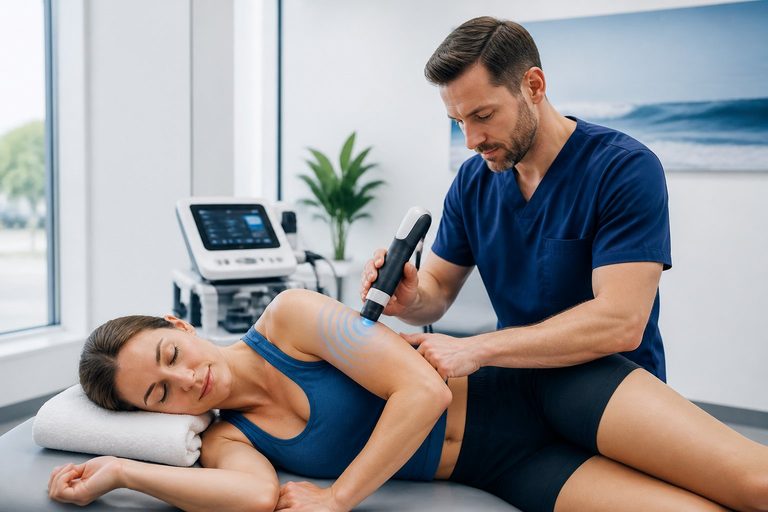
When an elbow has hurt for months, and home care has plateaued, shockwave therapy targets the tissue itself. Stemwave is a form of extracorporeal shock wave therapy delivered right through the skin.
What Focused Acoustic Waves Are Designed to Do
A handheld applicator sends focused acoustic waves into the damaged tendon. No needles or numbing are required. You feel a firm tapping or pulsing sensation, and a typical session runs about 10 to 15 minutes.
Those waves increase blood flow to tissue that naturally has poor circulation. The goal is to wake up a stalled repair response, encourage new collagen, and reduce the pain signaling that has become the tendon’s normal state.
Who May Consider Shockwave Therapy
This approach makes the most sense when tendon damage has become chronic:
- Elbow pain lasting longer than three months
- Little progress after a solid trial of rest, bracing, and exercise
- Pain that returns as soon as you resume work or sport
- A preference for drug-free, nonsurgical pain management
Most people complete a short series of sessions and continue their exercises between visits.
Pairing Tissue Care With Whole-Arm Mechanics
An elbow rarely fails in isolation. A stiff shoulder, restricted mid-back, or wrist that does not extend well forces the elbow tendons to absorb extra load every single day.
Pairing Stemwave with chiropractic adjustments and soft tissue work addresses that compensating strain. As range of motion improves through the shoulder and wrist, grip strength usually follows, because the elbow stops doing another joint’s job. Some cases still warrant a broader medical workup.
When a Clinical Evaluation and Advanced Options Make Sense
A hands-on exam answers most questions quickly. Imaging and procedures come into play when the picture is unclear, or the pain refuses to budge.
How Tennis Elbow Is Diagnosed
Tennis elbow diagnosis usually starts with your history and a physical exam. A provider presses on the epicondyle and asks you to resist wrist and finger movements to reproduce the pain.
Providers order X-rays, MRI, or electromyography only when they suspect something else, such as arthritis, a fracture, or nerve involvement. Most people never need them.
Injections and Procedures to Discuss Carefully
Steroid injections can calm pain quickly, but research shows worse long-term outcomes than exercise-based care, so they deserve a careful conversation. A landmark randomized trial found injections outperformed physiotherapy at six weeks, but by 52 weeks the injection group had significantly worse outcomes and far higher rates of the pain coming back. Platelet-rich plasma injections aim to stimulate healing rather than suppress it.
Tenex, also called ultrasonic tenotomy, uses ultrasound guidance to break down and remove damaged tissue through a tiny opening. Open surgery or arthroscopic surgery is generally reserved for pain lasting 6 to 12 months despite good conservative care. TENS units may help control symptoms but do not repair tissue.
Signs You Should Not Ignore
Get evaluated sooner if you notice numbness or tingling into the hand, visible swelling, a locking or catching elbow, sudden weakness, or pain following a fall. Those point to something beyond routine tendon overload.
Most people, though, have a treatable tendon problem and a path back to normal function.
Frequently Asked Questions
What Is the Fastest Way to Relieve Elbow Pain and Return to Normal Activities?
Start by changing the two or three motions that flare it, ice after activity, and use a forearm strap during heavy tasks. Then add gentle loading exercises within days, not weeks. Rest alone eases pain temporarily but delays the tendon rebuilding you need.
What Exercises Can Help Strengthen the Tendon and Prevent Pain From Coming Back?
Slow wrist extension lifts, wrist turns, a towel twist, and a light ball squeeze build tendon capacity when done with control. Pair them with a wrist stretch held 20 to 30 seconds. Progress the weight gradually, and expect mild soreness that settles within 24 hours.
Should I Wear an Elbow Brace, and How Do I Choose the Right One?
A forearm counterforce strap sits just below the elbow and offloads the tendon during gripping or lifting. Wear it for demanding tasks, not around the clock, because constant support can weaken your forearm muscles. Comfort and correct placement matter more than brand.
What Activities Should I Avoid While My Elbow Is Healing?
Limit repeated palm-down lifting, hard gripping, and prolonged typing with your wrists angled upward. You do not need to stop moving. Switch to palm-up lifting, use both hands on heavy items, and take short breaks during repetitive activity.
When Should I See a Chiropractor or Other Provider for Persistent Elbow Pain?
If pain lasts beyond six weeks, keeps returning after rest, or limits work and sleep, get evaluated. Also seek care right away for numbness, tingling, swelling, or weakness in the hand. An exam clarifies which tendon is involved and what is loading it.
Can This Condition Heal Permanently, or Is It Likely to Return?
Most cases resolve with structured care, and studies report the large majority recover without surgery. Recurrence usually happens when strengthening stops early, or the original mechanics never change. Keeping up forearm and shoulder work protects the result long term.
Move, Grip, and Work With More Confidence Again
Effective tennis elbow treatment is not about hiding the pain. It is about restoring the tendon’s ability to handle the gripping, lifting, and typing your life requires.
That means combining smart activity changes, progressive strengthening through physical therapy, and, when healing has stalled, tissue-level care like Stemwave. Layer in an honest look at how your shoulder and wrist move, and you address the cause instead of the symptom. Grip strength returns, mornings loosen up, and you stop planning your day around your elbow.
If elbow pain has been shrinking what you can do, Metro Acute Chiropractic can help you find out what is actually driving it. With more than 16 years of experience and thousands of patients treated, our team in Lone Tree builds a plan around your specific arm, your work, and your goals. Request an appointment or call us, and let’s get to the root of it together.