You reach for a mug on the top shelf, or you go to fasten a seatbelt, and your arm stops short. Not sore exactly, but locked, like something inside the joint refuses to let go. Sleeping on that side becomes impossible, and reaching behind your back to grab a wallet or hook a bra strap turns into a small negotiation with pain.
That deep, gripping stiffness usually means the shoulder joint capsule itself has tightened, and pushing harder rarely fixes it. Care that looks at the whole picture (how the shoulder blade moves, how the neck and upper back contribute, and what is happening inside the joint) often goes further than stretching harder and hoping.
Effective frozen shoulder treatment works with your current range of motion instead of forcing through it, calming pain first so movement can return. In this guide, you will learn what changes inside the joint, how to recognize which stage you are in, what a proper diagnosis rules out, and which nonsurgical options actually move the needle.
Why Your Shoulder Feels Locked Up
Frozen shoulder, medically known as adhesive capsulitis, isn’t a muscle problem. The tissue that wraps around your shoulder joint thickens and tightens, and that shrinking sleeve is what stops your arm.
What Adhesive Capsulitis Changes Inside the Joint
Your shoulder is a ball-and-socket joint. The head of the humerus sits in a shallow socket called the glenoid, part of the scapula, and a flexible bag of tissue called the shoulder capsule holds it all together.
Normally, that capsule is loose enough to let your arm circle freely. With adhesive capsulitis, it becomes inflamed, thick, and stiff. The joint space shrinks, so the ball has less room to glide.
That is why the limit feels structural rather than sore. You are not fighting a tight muscle you can stretch out. You are running into a capsule that has physically shrunk around the joint.
How Inflammation, Scar Tissue, and Less Lubrication Limit Motion
Inflammation comes first. As it lingers, bands of scar tissue form inside the capsule and stick surfaces together that should slide.
At the same time, the joint produces less synovial fluid, the natural lubricant that lets cartilage surfaces move quietly against each other. Less fluid plus thicker tissue equals grinding resistance with every reach.
The rotator cuff muscles then start guarding. They tighten to protect the joint, which further shrinks your usable motion and can be mistaken for bursitis or tendinitis.
Common Triggers and Health Factors
Frozen shoulder often starts after something else made you hold the arm still. It also shows up more often alongside certain health conditions.
- A prior shoulder injury, fracture, or surgery that required a sling
- Long periods of immobility, including recovery from an unrelated procedure
- Diabetes, which raises risk significantly
- Thyroid disorders, both hypothyroidism and hyperthyroidism
- Heart disease, Parkinson’s disease, or recovery from a stroke
- Lingering bursitis or tendinitis that made you avoid using the arm
Knowing your triggers matters, but so does knowing where you are in the process, because the right care changes as the shoulder changes.
Recognizing the Recovery Stages
Frozen shoulder moves through three stages, and each one calls for a different approach. Matching your care to your stage is the difference between progress and flare-ups.
Freezing Stage: Pain Builds as Motion Narrows
This stage usually lasts several weeks to nine months. Pain leads the way, often worst at night and sharp at the end of any reach.
Because it hurts, you naturally move less. That protective habit speeds up the stiffening, so range of motion narrows week by week even though the capsule change is still early.
Aggressive stretching now tends to backfire. The joint is inflamed, and forcing it triggers more guarding and more pain.
Frozen Stage: Stiffness Becomes the Main Barrier
Somewhere between four and twelve months in, the sharp pain often settles. What remains is the stiffness, and it can be dramatic.
You may lose most of your ability to rotate the arm outward or reach behind your back. Everyday tasks like washing your hair or reaching a back pocket become the clearest frozen shoulder symptoms you notice.
This stage is where careful, consistent mobility work earns the most ground. Pain is lower, so your tissue tolerates more movement than it did before.
Thawing Stage: Rebuilding Movement Gradually
Motion starts returning, usually between six months and two years from onset. It rarely comes back all at once. You will notice one direction loosening before another.
Strength lags behind mobility because the shoulder has been underused for a long stretch. Rebuilding that strength protects the gains you just made.
Whichever stage you are in, one question needs answering first: is this actually frozen shoulder?
Getting the Right Diagnosis Before You Push Through Pain
Several shoulder problems cause pain and stiffness, and they need different care. A careful exam sorts them out before you start stretching something that should be resting.
What a Physical Exam Can Show
A clinician will move your arm in specific directions and compare two things. Active range of motion is how far you can move the arm yourself. Passive range of motion is how far it goes when someone else moves it while you relax.
Frozen shoulder limits both. That is the signature finding. Outward rotation is usually most restricted, followed by overhead reaching and inward rotation behind the back.
If your passive motion is much better than your active motion, the problem is more likely muscle- or tendon-based, not capsular.
When X-Ray, MRI, or Ultrasound Helps Rule Out Other Problems
Frozen shoulder is usually diagnosed from your history and exam alone. Imaging is used to rule things out rather than confirm it.
An X-ray checks for arthritis in the shoulder joint or old fracture changes. Ultrasound can show a rotator cuff tear or inflamed bursa in real time. An MRI gives the most detail when the picture stays unclear, or symptoms are severe.
The Mayo Clinic notes that imaging is used mainly to exclude other conditions, which is why a good exam still comes first.
How Frozen Shoulder Differs From Rotator Cuff Damage and Arthritis
A rotator cuff tear tends to cause weakness with specific movements while passive motion stays fairly full. Frozen shoulder causes a hard stop in every direction, with or without weakness.
Arthritis often brings grinding, crepitus, and pain that tracks with weather or activity level. Bursitis and tendinitis usually hurt in an arc of motion, then ease past it.
Once you know it is the capsule, the plan becomes clearer, and most of it does not involve a scalpel.
Building a Nonsurgical Plan for Pain Relief and Mobility
Most frozen shoulders improve without surgery. The right plan pairs pain relief with movement your joint can tolerate today.
Using Medication and Heat Without Masking the Problem
Nonsteroidal anti-inflammatory drugs like ibuprofen or aspirin can lower pain and inflammation enough to let you move. That is their real job here: opening a window for movement.
Heat before exercise helps too. A warm shower or heating pad for ten minutes loosens surrounding tissue so stretching feels less like a fight. Some people get relief from a TENS unit, which uses transcutaneous electrical nerve stimulation to quiet pain signals.
The trap is using medication to power through a workout or a work task the shoulder is not ready for. Pain relief should buy you gentle movement, not permission to force it.
Gentle Stretching and Home Exercises That Respect Your Limits
The rule is simple. Work to the edge of stiffness, not into sharp pain, and stop before your shoulder starts guarding.
- Pendulum stretch: lean forward, let the arm hang, and swing small circles
- Towel stretch: hold a towel behind your back and use the good arm to gently pull
- Cross-body reach: use the healthy arm to lift the affected arm across your chest
- Finger walk: face a wall and walk your fingers up it slowly
Do these range-of-motion exercises several times a day in short sessions rather than one long push. Frequency beats intensity with a stiff shoulder joint capsule.
How Physiotherapy, Chiropractic Care, and Stemwave Can Work Together
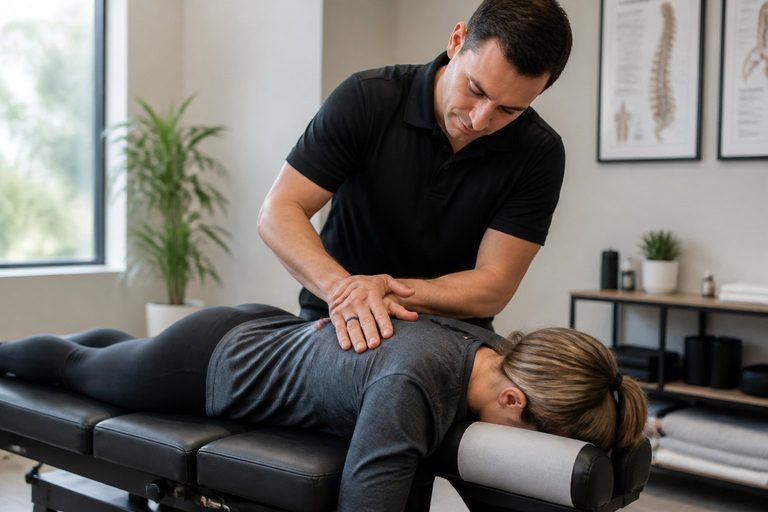
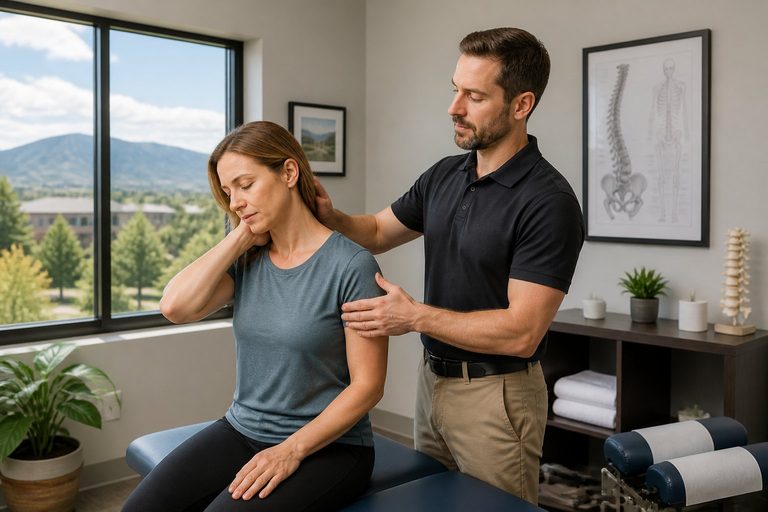
Physiotherapy and hands-on care restore how the shoulder blade and joint move together. Adjustments to the upper back and neck matter more than people expect, since a stiff thoracic spine forces the shoulder to compensate. Chiropractic care addresses that upper back and neck contribution directly.
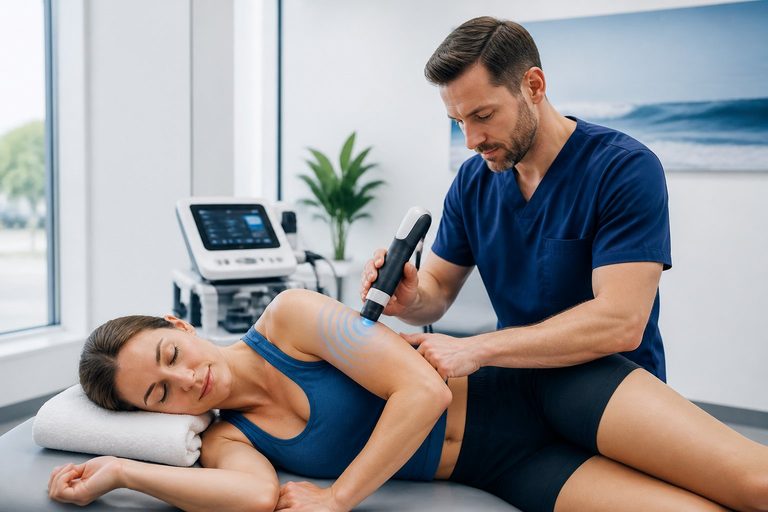
Stemwave therapy adds something the stretching alone cannot. During a session, a handpiece delivers focused acoustic waves through the skin around the joint. It feels like firm tapping, takes about ten to fifteen minutes, and requires no needles, numbing, or downtime.
Those waves increase blood flow and stimulate the body’s repair response in stalled tissue. For a capsule thickened with scar tissue, that means softer, more responsive tissue and less pain, which often shortens the thawing phase and makes each stretching session productive instead of painful.
If months go by with no change, a few other options are worth discussing.
When Injections or Procedures May Be Worth Discussing
Some shoulders stay stubborn. When pain blocks all progress or motion stops improving, injections and procedures become reasonable topics, not failures.
What a Corticosteroid Injection May and May Not Do
A steroid injection into the shoulder joint can meaningfully reduce pain and improve range of motion, especially when given early in the freezing stage. Lower pain means you can finally do the mobility work.
What it will not do is dissolve a thickened capsule. Steroid injections buy comfort and time. The motion still comes from movement, which is why they work best combined with therapy, not instead of it.
Effects also fade, often over weeks to a few months. Repeat injections are limited because too many can weaken the tendon tissue around the joint.
Deciding Whether More Invasive Care Is Appropriate
Manipulation under anesthesia involves being asleep while a surgeon moves the joint through its full range to break up adhesions. Shoulder arthroscopy with capsular release uses small instruments and a camera to cut tight bands of scar tissue directly.
Both are uncommon and usually reserved for people who have given conservative care a genuine six to twelve months without gaining ground. Both also require committed rehab afterward, or the stiffness returns.
Questions to Ask When Recovery Has Stalled
- Has my range of motion actually changed in the last eight weeks, measured, not guessed?
- Is pain or stiffness the thing limiting me right now?
- Have we addressed my neck, upper back, and shoulder blade, or only the shoulder?
- Is there an underlying condition, like diabetes or a thyroid disorder, that needs better control?
Those answers usually point toward a next step, and for most people that step is still conservative.
Frequently Asked Questions
What Are the Best Ways to Relieve Frozen Shoulder Pain and Restore Movement?
The most reliable combination is pain control plus frequent gentle motion: anti-inflammatories or heat to calm the joint, then short range-of-motion sessions several times daily. Hands-on care and Stemwave therapy can reduce pain enough to make those sessions productive.
Which Exercises Can Safely Improve Shoulder Mobility at Home?
Pendulum swings, towel stretches, cross-body reaches, and finger walks up a wall are safe starting points for most people. Move to the edge of stiffness and stop before sharp pain, and repeat in short sessions rather than one long stretch.
How Can I Sleep Better When Frozen Shoulder Pain Is Worse at Night?
Sleep on your unaffected side with a pillow supporting the sore arm in front of you, or on your back with a pillow under that elbow. A warm shower and gentle pendulum swings before bed often reduce the aching that wakes you.
What Medicines or Injections Can Help Manage Frozen Shoulder Pain?
Over-the-counter NSAIDs like ibuprofen or aspirin help with everyday pain and inflammation. A corticosteroid injection into the shoulder joint can provide stronger relief, and it works best early in the freezing stage alongside active therapy.
How Long Does It Usually Take for a Frozen Shoulder to Heal?
Left alone, frozen shoulder commonly takes one to three years to run through all three stages. With consistent treatment started early, many people see meaningful gains in pain and motion within a few months.
When Should I See a Chiropractor or Other Clinician for Persistent Shoulder Stiffness?
Get evaluated if stiffness has lasted more than a few weeks, is limiting sleep or daily reaching, or is steadily getting worse. Early care makes a real difference, and an exam also rules out a rotator cuff tear or arthritis before you start stretching.
Take the Next Step Toward Easier Shoulder Movement
The most useful thing to know about frozen shoulder treatment is that patience and consistency beat force every time. Shoulders that get gentle, frequent movement paired with real pain relief regain range of motion faster than shoulders that are stretched hard once a week.
You do not have to guess which stage you are in or which home exercises are safe for it. A proper exam tells you where your shoulder stiffness is coming from, and a plan built around your stage keeps you moving forward instead of flaring up.
If reaching, lifting, or sleeping on that side has slowly gotten worse, Metro Acute Chiropractic can help you find what’s driving it. Take the first step toward lasting relief. Schedule a visit with our team in Lone Tree to learn what personalized care can do for your shoulder.