A mild Grade 1 hamstring strain usually takes one to three weeks, a Grade 2 partial tear roughly three to eight weeks, and a Grade 3 complete tear three months or more. The grade of your injury is the best early guide to your pulled hamstring recovery time.
The calendar is only half the story, though. Hamstring strains are notorious for coming back, with studies of athletes reporting re-injury rates somewhere between 12% and about 33%, many soon after a return to sport. Your leg can feel fine on a walk while still lacking the strength it needs for a sprint, a steep trail or a quick cut on the court.
Recovery Time by Grade
The hamstrings are three muscles on the back of the thigh: the biceps femoris on the outside and the semitendinosus and semimembranosus on the inside. Injuries to the biceps femoris, injuries high up near the buttock and injuries that involve the tendon all tend to take longer.
Grade 1: Mild Strain (About 1 to 3 Weeks)
A small number of fibers are overstretched or torn. You feel tightness or a pull mostly when you stretch or speed up, while walking stays normal or close to it. The trap with Grade 1 strains is how quickly they feel better. Pain fades in days, so people go back to sprinting before strength has caught up.
Grade 2: Partial Tear (About 3 to 8 Weeks)
You may feel a sharp grab or pop, then limp. Bruising on the back of the thigh often appears a day or two later, and bending the knee against resistance feels clearly weak. Steady rehab the whole way through matters more than rest.
Grade 3: Complete Tear (Three Months or More)
A full tear of the muscle or tendon usually comes with a loud pop, sudden severe pain, trouble walking and heavy bruising, sometimes with a visible gap or bunched-up muscle. Slipping on ice into a split is a classic cause. When the tendon pulls off the pelvis, surgical reattachment may be recommended.
What Stretches the Timeline
Tendon tissue has less blood supply than muscle, so strains reaching the tendon heal more slowly. A previous hamstring injury on the same side also adds time, because scar tissue and leftover weakness leave the area vulnerable.
What Helps It Heal Without Setbacks?
The First 48 to 72 Hours
Protect the muscle with relative rest, ice for 15 to 20 minutes several times a day, compression shorts or a wrap, and elevation when you can. Short, easy walks within comfort help more than staying on the couch. Skip hard stretching and deep massage in these early days, since both can strain fresh tissue.
Progressive Loading
This step does the most to protect you from re-injury. A typical progression goes from gentle isometric holds (pressing your heel into the floor) to bridges, then hamstring curls and hip hinges like Romanian deadlifts, and later faster, more athletic movements. Mild discomfort is fine; sharp pain or soreness that lingers into the next day means back off a step.
Hands-On Care and Stalled Strains
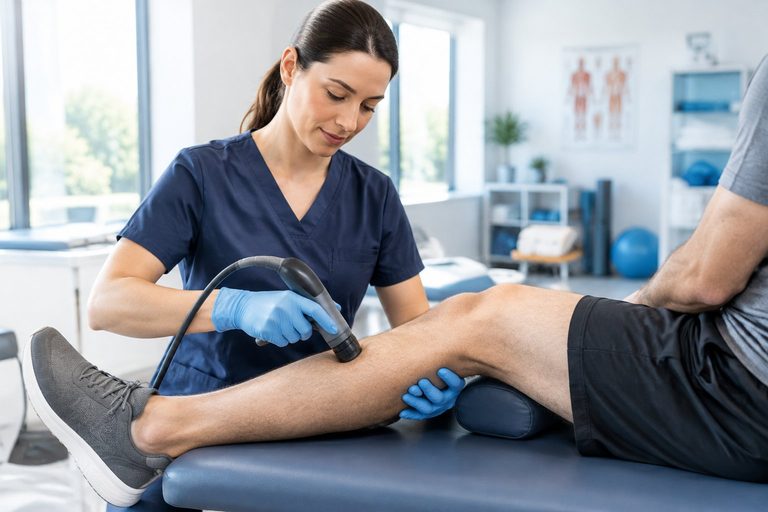
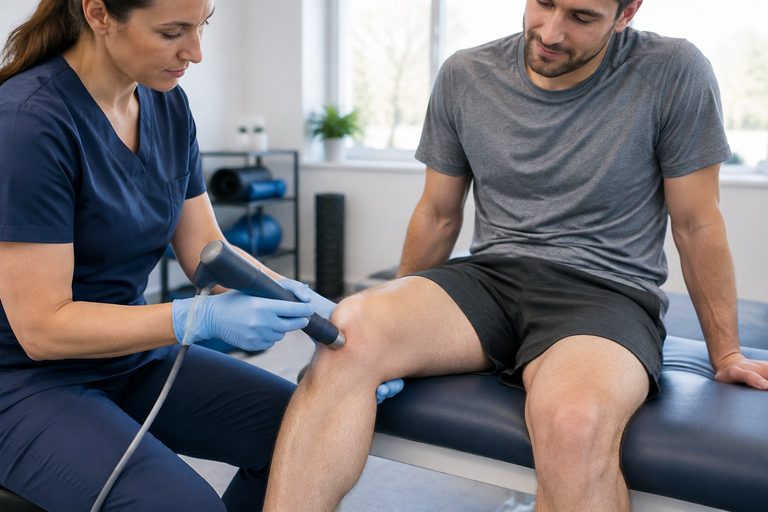
Once the acute stage passes, massage and myofascial work ease guarding and stiffness, and kinesio taping can offer light support as you return to activity. If a strain stalls for months or keeps flaring, StemWave focused shockwave can help restart healing by improving circulation and encouraging new blood vessel growth in tissue that has stopped making progress. You can read more on our StemWave therapy in Lone Tree page.
Worried your hamstring will grab again the next time you sprint? We test your strength side to side, check your hips and lower back, and plan each stage of your return with you so you get back to full speed with confidence. Call (303) 221-3342 or request an appointment online.
When to See a Doctor First
Go to urgent care, the emergency room or a sports medicine physician for a loud pop with sudden severe pain high near the buttock, a dent or balled-up muscle on the back of the thigh, being unable to walk, rapidly spreading bruising, numbness or weakness down the leg, or calf swelling and warmth that could point to a blood clot. Suspected tendon avulsions are time-sensitive, because surgical repair goes best when done early.
If a strain keeps returning, there is usually a reason: leftover weakness, scar tissue, poor hip and pelvis control, or pain actually coming from the lower back. Finding the driver early saves time.
How Do You Know You Are Ready to Return?
Progress should be based on what your leg can do. Before going back to full sport you should have no pain when the muscle is pressed or contracted, full range of motion compared with your other side, close to equal hamstring strength, and pain-free single-leg bridges and hip hinges.
Build speed in stages: brisk walking, light jogging, strides at about 60 to 70% effort, then 80 to 90%, then full sprints, with change of direction and sport drills last. Move up only when the current stage feels easy the next day.
Nordic Curls to Prevent the Next One
Nordic hamstring curls, where you kneel with ankles held and slowly lower your body forward, are one of the best prevention tools available. Research pooling thousands of athletes found adding them to prevention programs cut hamstring injury rates roughly in half. Save them for later rehab, once you have solid pain-free strength, and build up slowly.
Getting back on the field, trail or court with a hamstring you can trust is the goal, and we would be glad to help you reach it. Drawing on our clinic’s 16+ years of treating athletes in Lone Tree, Dr. Jacob Alvis can assess your injury, measure where your strength stands and build a sports-focused plan through our athletic recovery therapy. We also work with active patients as a sports chiropractor in Lone Tree, serving Highlands Ranch, Parker and Centennial. Call (303) 221-3342 or request an appointment online.
Frequently Asked Questions
Can I walk with a pulled hamstring?
Usually, yes, with a Grade 1 or mild Grade 2 strain, and short easy walks help healing. If you cannot bear weight or walk without a heavy limp, see a doctor to rule out a severe tear.
Should I stretch a pulled hamstring?
Wait a few days, then stretch gently within comfort. Pair it with strength work, since stretching alone does not rebuild a damaged hamstring.
Why does my hamstring still hurt after several weeks?
Lingering pain usually points to leftover weakness, scar tissue, tendon involvement or pain referred from the lower back. A reassessment helps find what is stalling progress.