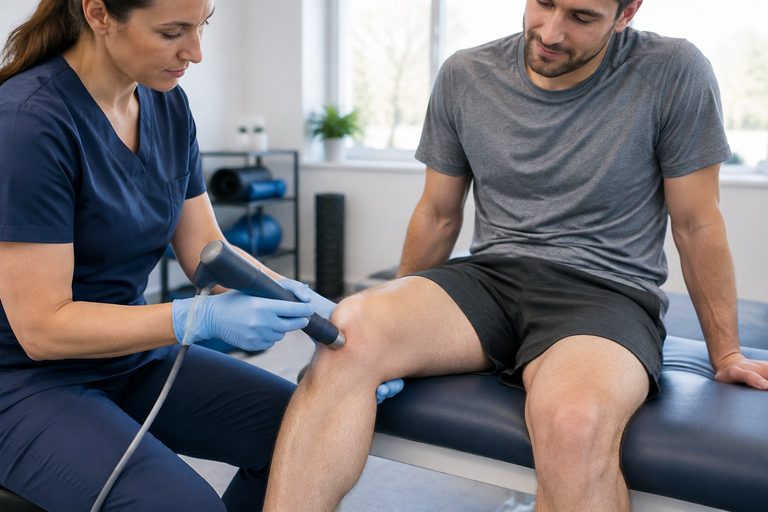
Shockwave therapy for golfer’s elbow uses focused acoustic waves to restart healing in a worn-down tendon on the inside of the elbow, and research suggests it can reduce pain and improve grip function over several weeks without injections or surgery. If your inner elbow stings every time you swing a club, grab a dumbbell or lift a gallon of milk, that is the outcome you are after.
Golfer’s elbow tends to linger. The tendon has a modest blood supply, and by the time most people seek help, it has moved from a fresh irritation to tissue that has stopped repairing itself. Rest calms it down, then the first round of golf or the first heavy pull at the gym brings it straight back.
What Is Golfer’s Elbow?
Golfer’s elbow, or medial epicondylitis, affects the tendon where the muscles that bend your wrist and turn your palm down attach to the bony bump on the inside of the elbow. Pain shows up with gripping, wrist curls and the downswing in golf.
It is a close cousin of tennis elbow, which affects the outside of the elbow and the muscles that pull the wrist back. If your pain sits on the outer side, our tennis elbow treatment guide is the better fit.
Despite the name, plenty of cases have nothing to do with golf. Carpentry, plumbing, climbing, pickleball, heavy lifting and long days of forceful gripping all load the same tendon. Under a microscope, a long-standing case shows disorganized collagen and very little true inflammation, which is why anti-inflammatories and rest often fall short.
How Shockwave Helps the Tendon Repair
Picture a worn elbow tendon as a building site where the crew has gone home. Focused shockwave delivers short, strong pulses into the tissue, and the tendon cells respond to that mechanical jolt by calling the crew back: blood flow picks up, new small blood vessels start to form and the body’s own repair cells get back to work. Over the following weeks, fresh collagen is laid down along the lines of stress.
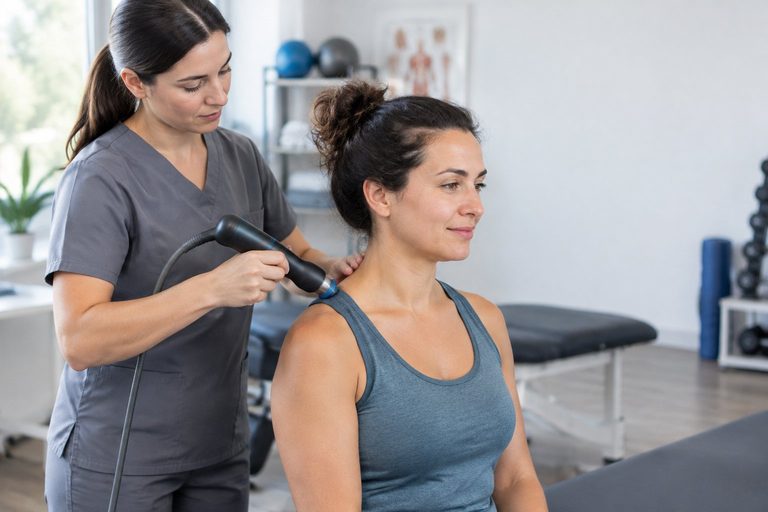
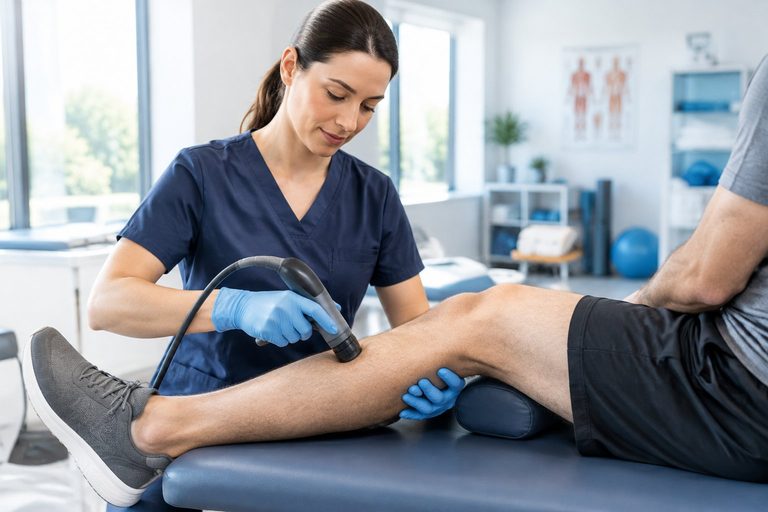
Dr. Jacob Alvis uses StemWave focused shockwave as a regenerative tissue therapy for exactly this kind of stalled elbow tendon. Studies on elbow tendon pain are encouraging, and results are strongest when shockwave is paired with a strengthening plan rather than used on its own.
What a Personalized Plan Involves
Finding the Overload
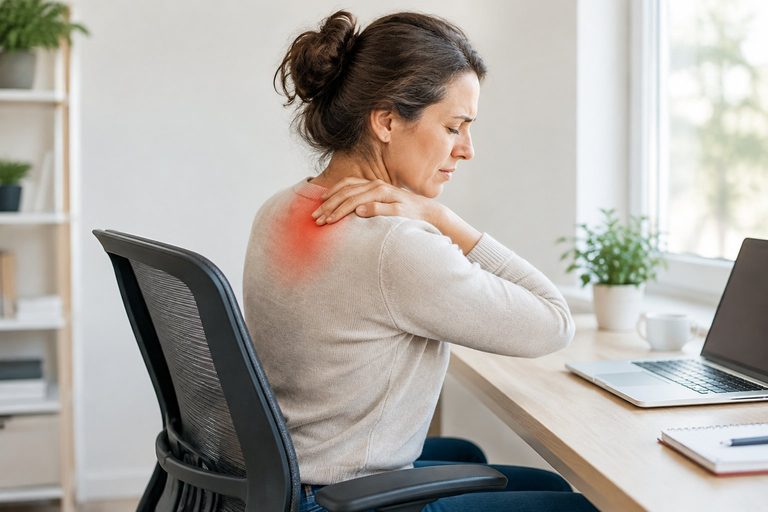
We start by working out what keeps irritating the tendon. For golfers, it is often a tight grip, fat shots or an aggressive release through impact. For lifters, pull-ups, rows and heavy deadlifts are common culprits. Office workers often clench a mouse for hours. We also check wrist, shoulder and neck mechanics, since a stiff shoulder or weak upper back can push extra load down to the elbow. Small changes help straight away, like a thicker grip on your club or tools, or swapping to neutral-grip handles at the gym.
The Shockwave Session
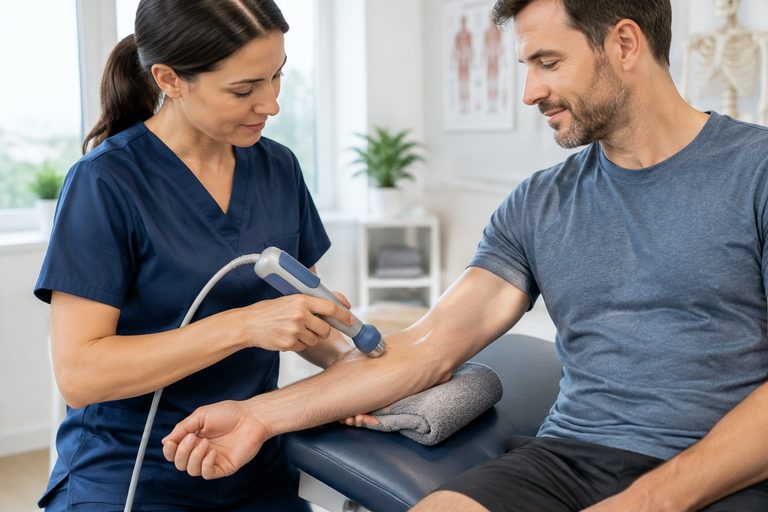
You sit with your arm resting on a table, gel goes on the skin, and the applicator is placed over the tender spot. You will feel a rhythmic tapping that can be uncomfortable right over the sore area, and intensity is adjusted to your tolerance. Sessions take less than 10 minutes, and you can use your arm normally afterward.
Grip and Forearm Strengthening
Shockwave restarts repair, and loading teaches the new tissue to handle force. We usually begin with isometric wrist flexion holds, which tend to calm pain, then move to slow wrist curls, forearm rotation work with a light bar and grip squeezes. As strength returns, the exercises become heavier and more sport-specific.
Supporting Tools
Acupuncture and myofascial release can ease tight knots in the forearm flexors that tug on the sore tendon. Kinesio taping offers light support during a round of golf or a long workday. Neither replaces strengthening, but both help you stay active while the tendon heals.
Wincing every time you grip a club or a dumbbell? We will track down what keeps overloading your inner elbow and combine focused shockwave with grip and forearm strengthening to help the tendon rebuild. Call (303) 221-3342 or request an appointment online.
What Recovery Looks Like
Many patients notice less pain in daily tasks within two to four weeks, with grip strength and tolerance for sport improving between weeks six and twelve as the tendon rebuilds. We track progress with grip testing, tenderness and how your elbow handles the tasks you care about, like 18 holes or a set of pull-ups.
You rarely need to stop everything. A simple rule: activity that keeps pain mild and settles by the next morning is fine. Pain that climbs the next day means you did too much. On the course, start with chipping and short irons and loosen your grip. In the gym, use straps for heavy pulls and drop the weight on curls for a few weeks.
When to Get Your Elbow Checked
Inner elbow pain deserves a proper assessment if it has lasted four to six weeks, returns every time you go back to golf or lifting, or comes with a weaker grip. Tingling in the ring and pinky fingers also deserves a look, since the ulnar nerve runs right behind the inner elbow. Get urgent medical care for an elbow that looks deformed after a fall, a hot red swollen joint with fever, or arm pain alongside chest pressure or shortness of breath.
Shockwave is not used during pregnancy, over an infection or tumor, or with a pacemaker, and blood thinners need careful review. We screen every patient before treatment begins. For more on how the device works, visit our StemWave therapy in Lone Tree page.
Getting golfers, lifters and hard-working hands back to full strength is some of our most rewarding work, and it is a big part of why Metro Acute Chiropractic has been a fixture in Lone Tree for more than 16 years. Bring your questions (and your swing habits) to Dr. Alvis, and he will show you exactly where shockwave fits in your plan. Call (303) 221-3342 or request an appointment online.
Frequently Asked Questions
Will golfer’s elbow go away on its own?
Mild cases can settle with rest and lighter activity over a few months. Cases that keep returning, or last beyond six weeks, usually involve a tendon that has stopped healing well and needs targeted loading and sometimes shockwave.
Is shockwave better than a steroid injection for golfer’s elbow?
Each has a role. Injections tend to calm pain faster in the first couple of weeks, while shockwave works on the tendon itself and its benefits build over time. Shockwave suits people who want a drug-free option or want to avoid repeat injections.
Can I keep playing golf during treatment?
Usually, yes, with adjustments. Shorter sessions, a looser grip and avoiding fat shots off hard turf help. Let next-day pain be your guide and build back to full rounds gradually.