Shockwave therapy for neck pain can help when stubborn pain comes from knotted, overworked muscles, especially trigger points in the upper trapezius running from the neck to the top of the shoulder. Clinical trials have found it lowers pain and tenderness in these knots, and it works best as part of a plan that also improves how your neck moves and how strong it is.
Maybe it is the knot that builds every afternoon at your desk in the Denver Tech Center, or the one that flares after a long drive up I-70 to the slopes. A massage helps for a day, then the tightness is back by Thursday. When a muscle keeps sliding back into the same tense, tender state, it has usually stopped recovering well on its own, and that is the kind of problem focused shockwave is designed for.
Which Neck Pain Responds Best?
Upper Trapezius Knots and Myofascial Pain
This is the main use for shockwave in the neck. Myofascial pain involves tight bands in a muscle with small, hard trigger points. Press one and it hurts on the spot, and it often sends pain into the head, jaw or shoulder blade. The classic example is the knot at the top of the shoulder you find yourself squeezing all day. Shockwave reaches that trigger point directly.
Desk-Driven Tension That Keeps Returning
Hours with your head pushed forward over a laptop load the muscles at the back of the neck for long stretches. Over time they guard, spasm and lose blood flow. Stretching relieves the feeling for an hour, then you sit back down in the same position. If that sounds familiar, the pattern often overlaps with text neck, and lasting change needs a better workstation setup and stronger postural muscles alongside treatment.
Disc and Nerve Problems Need a Different Plan
Sharp or burning pain, numbness or tingling running down the arm points to a pinched nerve, disc problem or narrowing in the spine. Shockwave does not decompress a nerve or repair a disc. It can ease the protective muscle spasm that comes with these problems, but the main plan needs to target the spine itself, so a full exam comes first.
How Shockwave Supports Muscle Healing
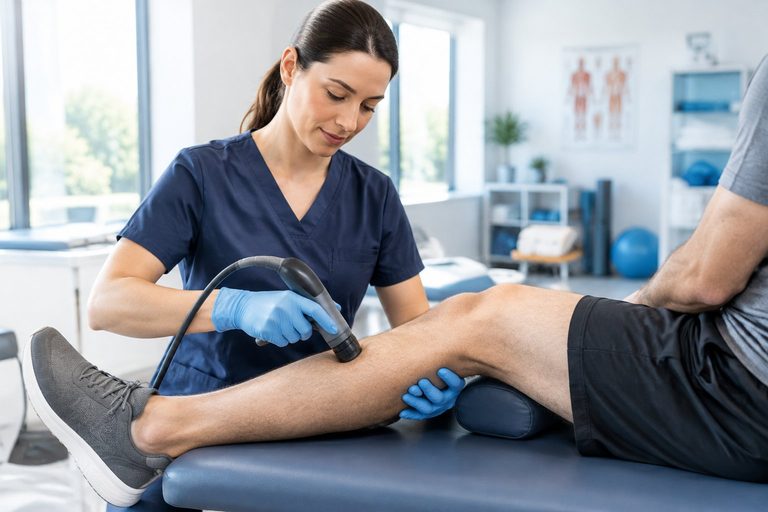
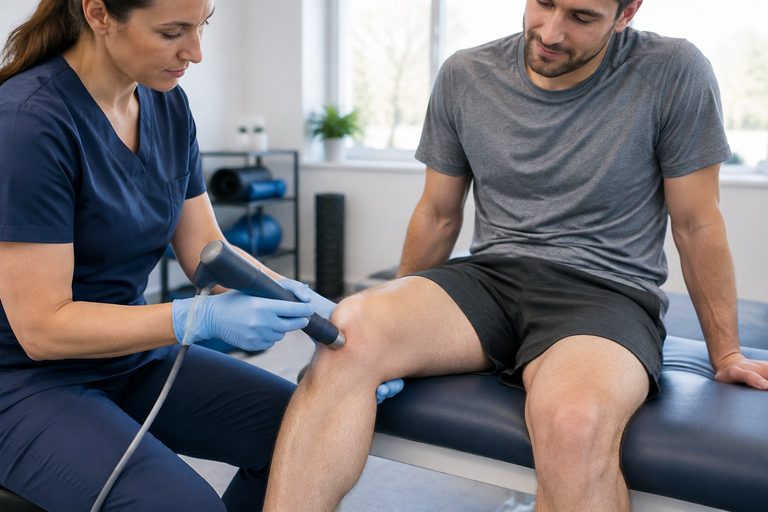
A trigger point is a small patch of muscle stuck in a contracted state. That contraction squeezes its own blood supply, irritating byproducts build up, and the soreness keeps the muscle guarded, so the loop feeds itself. Shockwave is aimed at breaking that loop. Pulses of acoustic energy travel through the skin into the knot, with no needles, incisions or electrical current, and the tissue responds by increasing local circulation and switching on its natural repair processes. Over a series of sessions, that better blood supply helps the muscle recover instead of staying locked in a tense, poorly fed state.
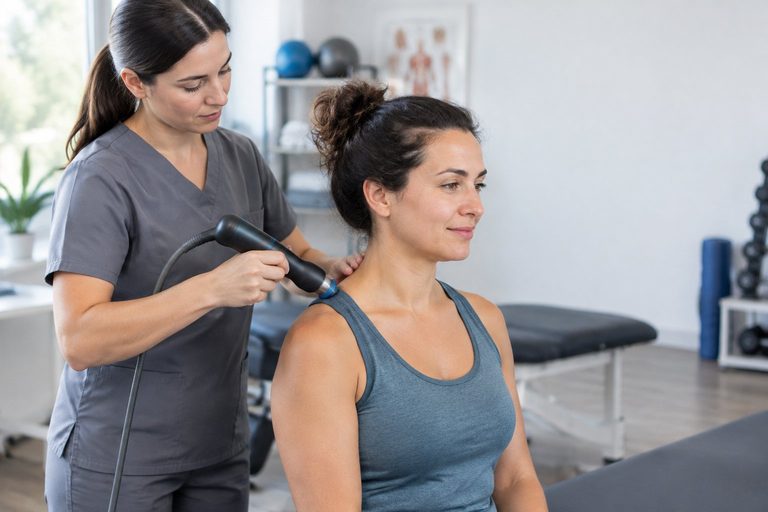
Studies on neck and shoulder muscle pain show the clearest benefits for pain and for how much pressure a knot can tolerate before it hurts. Improved neck rotation is common too, as the trapezius relaxes. We use StemWave, a focused device, which lets us aim the energy at a specific knot.
Safety: Where Treatment Is and Is Not Applied
The front of the neck holds the carotid arteries, the windpipe and the thyroid, so shockwave is never applied there. Treatment also stays off the bony spine itself. The waves go into the muscles along the back and sides of the neck and across the upper shoulders, where trigger points live. This is one reason a trained clinician should always perform it.
Side effects are usually limited to brief redness, tenderness or mild bruising. Let your provider know if you are pregnant, take blood thinners, have a bleeding disorder, a pacemaker, an active infection or a recent steroid injection in the area.
Ready for that shoulder knot to finally let go? Our Lone Tree team will map out your trigger points, check how your neck and upper back move, and talk you through whether StemWave focused shockwave is a good fit for you. Call (303) 221-3342 or request an appointment online.
What Treatment Looks Like
Assessment First
We ask about your pain, your work setup and your health history, then check neck motion, arm strength and reflexes and press along the muscles to find trigger points. This confirms whether your pain is mainly muscular and whether shockwave is right for you.
Sessions and Progress
You sit or lie down, a little gel goes on the skin, and the applicator moves over the tight muscle. Patients often describe it as the knot finally being found and worked from the inside. Many notice change within a few weekly sessions, while tissue repair keeps building for weeks. We track pain scores, knot tenderness and how far you can turn and tilt your head.
How It Fits With Adjustments and Exercise
Adjustments restore motion in stiff neck and upper back joints, which takes strain off the muscles. Soft tissue work loosens the layers around them. Strengthening the deep neck flexors and the muscles between the shoulder blades holds the gains so your neck can handle long workdays. Our neck pain care brings these together in one plan.
When to Seek Medical Care First
Go to the emergency room for neck pain after a crash or fall, a stiff neck with fever or a severe headache, sudden weakness or trouble walking, or chest pain spreading into the jaw or arm. These need medical attention before any chiropractic care.
Picture getting through a full workday without reaching up to squeeze that knot! Our Lone Tree clinic has been treating neck pain for more than 16 years, and during your first visit Dr. Alvis can tell you whether StemWave is the right next step for your neck. You can learn more on our StemWave therapy in Lone Tree page, visit us at 9898 Rosemont Ave, call (303) 221-3342 or request an appointment online.
Frequently Asked Questions
Can shockwave therapy help a pinched nerve in the neck?
It is not a primary treatment for a pinched nerve, because it does not take pressure off the nerve root. It can ease the tight, guarding muscles around an irritated area once a spinal exam has shaped the main plan.
Why won’t my neck pain go away despite stretching?
Stretching eases tight muscles briefly but does not change what keeps loading them. If you go back to the same low screen and the same tired postural muscles every morning, the knot rebuilds by lunchtime. Lasting progress usually comes from treating the trigger point while also freeing up stiff joints and strengthening the muscles that hold your head up.
How many sessions might I need for neck knots?
Many people need around four weekly sessions, depending on how long the pain has been there and how the tissue responds. We measure pain and motion at each visit and adjust from there.